A/B Testing Your Landing Page: A Practical Guide to Best Practices
 Grademypage Team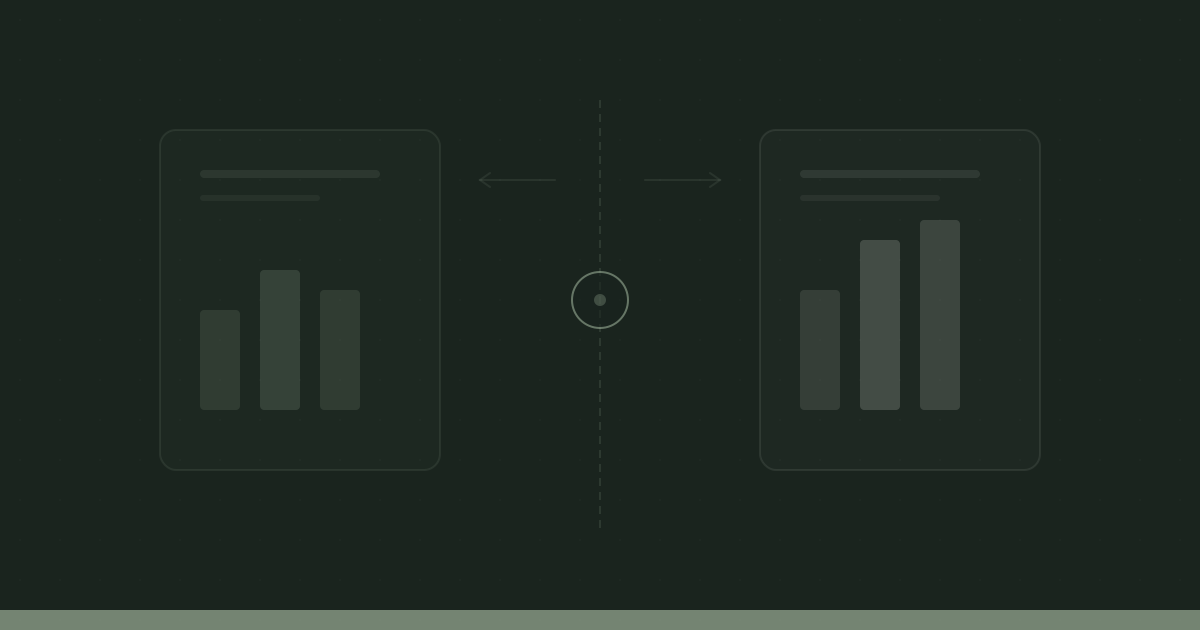
You've built your landing page, launched it, and traffic is coming in. Conversions are happening, but you have a nagging feeling the page could do better. Maybe the headline isn't quite right. Maybe the CTA button should be a different color. Maybe the form is asking for too much information.
Guessing doesn't solve this. A/B testing does. It's the most reliable way to improve landing page performance because it replaces opinions with evidence. But running a bad A/B test is worse than running no test at all; it gives you false confidence in wrong conclusions. Here's how to do it right.
What Is A/B Testing?
A/B testing, also called split testing, is a method of comparing two versions of a page to see which one performs better. You take your existing page (the control, or version A), create a variation with one specific change (version B), and split your traffic evenly between them. After enough visitors have seen both versions, you compare the conversion rates and declare a winner.
The key principle is isolation. By changing only one element at a time, you can attribute any difference in performance directly to that change. If you change the headline and the button color and the form length simultaneously, you'll never know which change actually moved the needle.
Why A/B Testing Matters for Landing Pages
Landing pages are high-leverage assets. A small improvement in conversion rate on a page receiving thousands of visitors translates directly to more leads, more sales, or more signups without spending an additional dollar on traffic.
Consider the math. If your landing page converts at 3% and gets 10,000 visitors per month, that's 300 conversions. Improving the conversion rate to 4% through testing gives you 400 conversions, a 33% increase in results from the same traffic. Over a year, that's 1,200 additional conversions from a series of incremental improvements.
A/B testing also removes the politics from design decisions. Instead of debating whether the headline should emphasize price or quality, you test both and let the audience decide. Data settles arguments faster than meetings do.
What to Test First
Not all elements have equal impact on conversions. Start with the changes most likely to produce measurable results.
1. Headlines
Your headline is the highest-leverage element on the page. It determines whether visitors engage with the rest of your content. Test fundamentally different approaches:
- Benefit-driven headline vs. curiosity-driven headline
- Specific and quantified ("Save 10 Hours a Week") vs. broad and emotional ("Take Back Your Time")
- Short and punchy vs. longer and descriptive
2. Call-to-Action
The CTA is where conversion literally happens, so even small improvements compound over time.
- Button text: "Start Free Trial" vs. "Get Started" vs. "See It in Action"
- Button color: High contrast vs. brand-consistent
- Button placement: Above the fold only vs. repeated throughout the page
- Button size: Larger and more prominent vs. standard
If you want a checklist of variables to test before you build your variations, our guide to designing CTA buttons that convert covers the specific decisions worth isolating.
3. Hero Image or Video
The visual in your hero section sets the emotional tone for the entire page.
- Product screenshot vs. lifestyle photography vs. illustration
- Static image vs. short video or animated demo
- Image with a person vs. image without
4. Form Length
If your landing page includes a lead capture form, the number of fields directly impacts completion rate.
- Full form (name, email, company, phone, role) vs. minimal form (email only)
- Single-step form vs. multi-step form that progressively asks for more information
- Form with optional fields marked vs. all fields required
5. Social Proof
Trust signals matter, and the type and placement of social proof can significantly affect conversions.
- Customer testimonials vs. client logos vs. usage statistics
- Social proof placed near the CTA vs. in its own section
- Named testimonials with photos vs. anonymous reviews
Before you start testing, it helps to know which elements on your page are weakest. Run an audit on Grademypage to identify specific areas where your landing page underperforms; that gives you a prioritized list of what to test first instead of guessing.
Understanding Statistical Significance
Statistical significance is what separates a real result from random noise. It tells you how confident you can be that the difference in conversion rates between your two variations is real and not due to chance.
What It Means
Most A/B testing tools use a 95% confidence level as the standard threshold. This means there's only a 5% probability that the observed difference happened by random chance. When your test reaches 95% confidence, you can trust the result.
Why It Matters
If you stop a test before reaching statistical significance, you might be acting on noise. Imagine flipping a coin 10 times and getting 7 heads. That doesn't mean the coin is biased; the sample is too small. The same logic applies to A/B tests. Early results can be wildly misleading.
How Long to Wait
The time required depends on your traffic volume and the size of the difference you're trying to detect. Use an A/B test duration calculator before you start. Input your current conversion rate, the minimum improvement you want to detect, and your daily traffic. The calculator will tell you how many days you need to run the test.
As a rough guideline:
- High-traffic pages (1,000+ visitors per day): Tests can reach significance in one to two weeks.
- Medium-traffic pages (200-1,000 visitors per day): Expect two to four weeks.
- Low-traffic pages (under 200 visitors per day): Tests may take a month or longer. Consider testing bigger, bolder changes so the effect size is large enough to detect with smaller samples.
Sample Size Considerations
Sample size is closely related to statistical significance. You need enough data points in each variation to produce a reliable result.
- Both variations need sufficient traffic. If you split traffic 50/50 and get 5,000 total visitors, each variation sees 2,500. That's usually enough to detect a meaningful difference.
- Don't split traffic unevenly unless you have a specific reason. A 50/50 split gives you the fastest path to significance.
- Account for conversion rate in your planning. If your current conversion rate is 1%, you need a much larger sample to detect a 10% relative improvement than if your conversion rate is 10%. Lower base rates require more data.
Common A/B Testing Mistakes
These mistakes are widespread, and each one can lead you to implement changes that actually hurt your performance.
Stopping Tests Too Early
This is the most dangerous mistake. You see version B outperforming version A after two days and declare a winner. But early results are volatile. The advantage might reverse completely over the next week. Always wait for statistical significance, even if the early data looks convincing.
Testing Too Many Things at Once
If you change the headline, the hero image, and the CTA button in a single test, you can't isolate what caused the result. You might implement all three changes when only one mattered, or worse, when two changes helped and one hurt, netting out to a marginal improvement that masks a missed opportunity.
Testing Trivial Changes
Changing your CTA button from "Submit" to "Submit Now" is unlikely to produce a statistically significant result with any reasonable sample size. Test changes that are meaningfully different. A new headline with a completely different value proposition will produce a bigger signal than tweaking the word order of your current headline.
Not Tracking the Right Metric
Make sure your primary metric is the one that actually matters. Click-through rate on a CTA button is useful, but if those clicks don't lead to completed form submissions or purchases, you're optimizing for the wrong thing. Always tie your test back to the bottom-line conversion goal.
Running Tests During Unusual Periods
A test that runs during Black Friday, a product launch, or a viral social media moment will produce results skewed by that unusual traffic. Run tests during normal business periods, and make sure both variations are exposed to the same traffic conditions at the same time.
Ignoring Segmentation
An overall winner might not be the winner for every segment. Version A might convert better on mobile while version B wins on desktop. If your testing tool supports segmentation, review results by device, traffic source, and geography before making a final call.
Tools for A/B Testing
Several tools make A/B testing accessible without requiring engineering resources for every test.
- Google Optimize was the go-to free option before it was sunset. Its successor integrations within Google Analytics 4 offer limited testing capabilities.
- VWO (Visual Website Optimizer) offers a visual editor for creating variations without code, plus robust statistical analysis.
- Optimizely is an enterprise-grade platform with advanced targeting, multivariate testing, and server-side capabilities.
- Convert focuses on privacy-friendly testing and integrates well with analytics platforms.
- Unbounce and Instapage are landing page builders with built-in A/B testing, useful if you're building pages from scratch.
For smaller teams or tighter budgets, even a simple approach works: create two versions of your page, use your ad platform to split traffic between them, and compare conversion rates manually once you have enough data.
A Simple Framework for Continuous Testing
A/B testing isn't a one-time activity. The highest-performing landing pages are the product of dozens of tests over months and years.
- Audit: Identify the weakest elements on your page. Use analytics, heatmaps, user recordings, and tools like Grademypage to find opportunities. Once you know what to test, our built-in experiments feature lets you run the variants without touching code.
- Hypothesize: For each weak element, write a clear hypothesis. "Changing the headline from feature-focused to benefit-focused will increase conversions because visitors care more about outcomes than technology."
- Prioritize: Rank your hypotheses by expected impact and ease of implementation. Test the high-impact, easy-to-implement changes first.
- Test: Run the test with proper sample size and duration.
- Analyze: Review results at the significance threshold. Implement the winner.
- Repeat: Move to the next hypothesis on your list.
Take Action
A/B testing transforms landing page optimization from guesswork into a disciplined, data-driven process. Start with the elements that have the biggest impact on conversions: headlines, CTAs, hero visuals, and form length. Change one thing at a time, wait for statistical significance, and track the metric that actually matters to your business.
The pages that convert best aren't the ones designed by the most talented team. They're the ones that have been tested the most. But before you start testing, you need to know where your page stands right now.
Paste your URL into Grademypage and get your score in under a minute. It's free, no account required.
See your page grade.
Paste any landing page URL and get an instant, AI-powered audit across 22+ factors.
Run a free auditFree · No account required · Results in ~1 minute